Michelle McNamara's Commitment to the Case
I'll Be Gone in the DarkMichelle McNamara's commitment to the case was both a sustained investigation and a moral response to the damage left by the Golden State Killer. Insomnia sent her back to suspect names, maps, and records; empathy kept the victims and their families in view when leads failed. Her work joined methodical research to a determination that the crime should not remain unanswered.
Research as a nightly practice
McNamara described insomnia as an opening for further investigation. When she could not sleep, she looked for East Area Rapist suspects, tracing names from Goleta cemetery records and alumni lists from Irvine schools, particularly Northwood. A rare surname and its geographic distribution seemed worth pursuing. The work was repetitive, but its repetition had purpose: she was looking for a connection that could turn a scattered set of clues into a person.
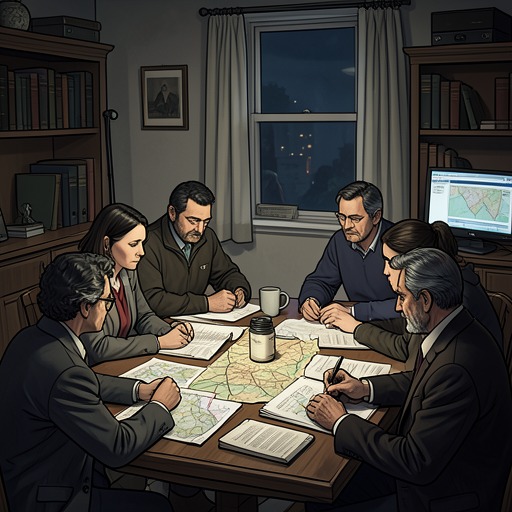
Her hard drive accumulated the material produced by that effort, including old maps and aerial photographs of Goleta that she compared with a map of the offender’s apparent movements. Rather than treat a map as a finished answer, she used it to generate questions about people, routes, and places. That investigative habit extended beyond her own files. She was drawn to how detectives could sort an abundance of clues, discard false leads, and build a path toward identifying an offender.
Reading the pattern and its human cost
Police reports gave McNamara a way to see the East Area Rapist’s activity as more than a sequence of separate attacks. The reports indicated that he studied neighborhoods as well as individuals: he often selected single-story houses near open areas, and signs of prowling, nearby break-ins, missing small items, and a rise in hang-up calls could precede an attack within a few blocks. Her reading brought these details together as evidence of reconnaissance and preparation, not random opportunity.
The reports also showed how knowledge of the offender changed the surrounding community. As public awareness grew, some residents who noticed suspicious activity became afraid to call police and instead locked their doors, turned off the lights, and withdrew into their homes. McNamara’s account emphasizes the gap between a promise of protection and the hesitation that can follow a scream, a figure crossing a fence, or a sound dismissed as ordinary. The point is not that neighbors caused the crimes, but that fear and isolation could leave people less able to respond to one another.
Individual details made the pattern harder to contain within any one household. The offender sometimes moved stolen objects from one victim’s home to another, and other evidence connected victims and nearby residents through shared circumstances. The apparent effect was to make his presence feel at once absent and pervasive. For McNamara, the reports’ value lay partly in tracing these links and partly in restoring the relationships and communities behind the case numbers.
The long delay in solving related murders supplied another measure of what an unresolved case could do to a family. Roger Harrington hired a private investigator, offered a reward, asked friends and co-workers for information, and revisited his memories of Keith and Patty Harrington’s lives before their deaths. He even consulted a clairvoyant, but no effort brought the answer he sought. After years of fruitless searching, he died in 1995, before forensic testing of three stored glass tubes led investigators toward a breakthrough. That sequence makes the case’s delays concrete: evidence could remain physically present while those waiting for an explanation did not live to learn what it disclosed.
Working with investigators and records
McNamara’s commitment took a collaborative form. She corresponded with people investigating the case and pursued leads herself, but she also sought out the documentary record that could be useful to law enforcement. When she and Paul Holes gained access to boxes of case materials, she helped turn them into searchable files by purchasing two high-volume scanners and scanning the reports. The collection included supplemental reports and overlooked items that had drifted outside the main case folders: forgotten suspects, witness accounts, vehicles that had not been followed up, and explanations offered by prowlers.
The scale of that archive changed her sense of where an answer might lie. She estimated that there was an 80 percent chance the offender’s name appeared somewhere in the boxes. That estimate was a working conviction, not a proven result: the documents held many possibilities, and the task was to search them without mistaking a promising lead for certainty. Digitizing the material also made it easier for investigators, including Holes, Ken Clark, and Erika Hutchcraft, to access and search records that had not all been seen by active investigators.
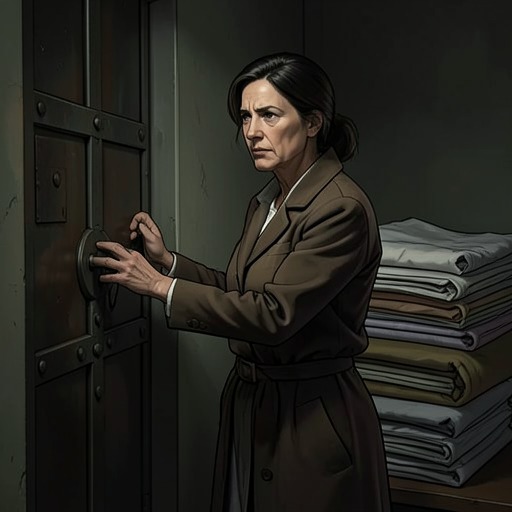
Genetic genealogy offered another possible route, but it was constrained by privacy protections and company policies. McNamara believed that comparisons using the killer’s actual genetic material might identify a cousin and, through that relative, point investigators toward the offender. The large profiles held by 23andMe and Ancestry.com made the possibility compelling to her, yet neither company would work with law enforcement, citing privacy issues and its terms of service. She understood the prospect as a potential lead, not a guaranteed identification, and saw the databases as a locked door with both privacy and legal questions behind it.
Persistence without the promise of glory
The account of McNamara’s work describes its personal cost as well as its rigor. Patton Oswalt recalled mornings when she was at her laptop, upset and exhausted after pursuing a lead that ended without an answer; after coffee, she would return to the search. Her commitment could displace sleep and affect her health. The book presents this intensity without treating it as a simple virtue: the pursuit gave her purpose, but it also demanded a great deal from her.
Oswalt characterized her motive as a desire for justice rather than recognition. McNamara said she did not need to be the person who captured the offender; she wanted him arrested and imprisoned. That distinction clarifies the nature of her persistence. Its measure was not whether her own name would be attached to a solution, but whether the work could help bring the case to an end and acknowledge the people whose lives the crimes had altered.
Her commitment therefore holds together two forms of attention: the close reading of maps, reports, names, and records, and an empathetic attention to survivors and bereaved families. The leads could fail, the answer could remain inaccessible, and the work could continue to intrude on ordinary life. McNamara kept returning to it because the uncertainty was not abstract: it had consequences for victims, relatives, investigators, and neighborhoods still living with what had happened.